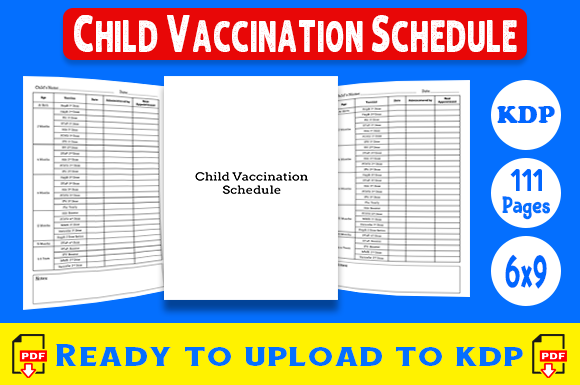
Streamlining KDP Publishing with a Ready-to-Use Child Vaccination Schedule Log Book Interior
The low-content and medium-content publishing sector on Amazon KDP has evolved significantly, moving beyond simple lined journals to specialized utility books that serve specific professional and personal needs. Among these high-value niches is the Child Vaccination Schedule Log Book, a resource that bridges the gap between medical record-keeping and parental peace of mind. For creators and publishers, the challenge often lies not in identifying the niche, but in producing a technically flawless interior that meets strict platform guidelines while providing genuine utility. Utilizing a pre-designed, tested interior download eliminates technical friction, allowing publishers to focus on marketing, keyword research, and audience targeting rather than graphic design troubleshooting.
Technical Specifications and Platform Compliance
Success in print-on-demand publishing relies heavily on adherence to precise manufacturing specifications. A common point of failure for new publishers is submitting files that are rejected due to margin errors, bleed issues, or resolution deficits. This specific Child Vaccination Schedule Log Book Interior Download addresses these pain points through rigorous pre-testing. The file is formatted specifically for the 6x9 trim size, which is widely considered the industry standard for portable health logs. This dimension offers an optimal balance between writing space and portability, fitting easily into diaper bags, glove compartments, or clinic waiting areas without feeling cumbersome.
Resolution is another critical factor. Blurry lines or pixelated text can lead to negative reviews and returns. The provided PDF files feature high-resolution interiors, ensuring that every table line, header, and instruction remains crisp after printing. Because the files have been explicitly tested on KDP, publishers can upload with confidence, knowing that the gutter margins account for binding thickness and that the safe zones respect the trimming process. This technical reliability transforms the product from a mere digital asset into a viable commercial inventory item ready for immediate deployment.
Functional Design Elements for Health Tracking
A vaccination log differs fundamentally from a standard diary or planner. It requires a structured layout that accommodates variable data points associated with immunization records. When evaluating or utilizing this interior, it is essential to understand the functional anatomy that makes it useful for end-users. Effective log books in this category typically include dedicated fields for:
- Vaccine Name and Type: Sufficient horizontal space to write full pharmaceutical names or abbreviations like DTaP, MMR, or Varicella.
- Date Administered: Clearly defined columns to track chronological progression and identify upcoming booster windows.
- Dose Number: Critical for multi-series vaccines where tracking partial completion is necessary for school enrollment or travel.
- Provider and Clinic Information: Space for stamps, signatures, or handwritten details of the administering healthcare professional.
- Lot Number and Manufacturer: Often overlooked in generic templates but vital for medical accuracy and adverse event reporting.
- Reaction Notes: A designated area for parents to document fever, swelling, or other post-vaccination observations.
The 6x9 format allows these elements to be arranged logically without cramping handwriting. Unlike digital apps, this physical interface provides a tangible backup that does not rely on battery life, internet connectivity, or software compatibility. For publishers, offering a layout that mirrors the actual workflow of pediatric visits increases the perceived value of the book compared to generic alternatives.
Diverse Audience Applications and Market Segments
While the primary end-user is obviously a parent or guardian, the market for a Child Vaccination Schedule Log Book extends into several adjacent demographics. Understanding these segments helps in crafting effective metadata and advertising copy. Foster care agencies and social workers frequently require portable, transferable records for children moving between placements. In these scenarios, a standardized log book serves as a crucial continuity-of-care document. Similarly, homeschooling families often need to maintain independent health records separate from public school systems, making a dedicated log book a compliance tool.
Healthcare providers and small clinics also represent a B2B opportunity. Pediatricians, family nurse practitioners, and vaccination pop-up clinics may purchase these books in bulk to provide to patients as a value-add service or to maintain physical backups alongside electronic health records. International travelers and expatriate families constitute another significant segment; they often navigate multiple healthcare systems across borders where digital interoperability is nonexistent. A universally formatted physical log becomes the single source of truth for their child’s immunization history. By recognizing these varied use cases, publishers can position the same 6x9 interior to satisfy multiple search intents.
Workflow Integration for KDP Publishers
Incorporating a ready-made interior into a publishing workflow significantly reduces time-to-market. The traditional creation process involves researching vaccination schedules, designing tables in InDesign or Canva, checking margins against KDP’s latest template generator, creating a test proof, and iterating based on errors. This cycle can take weeks. With an instantly downloadable, pre-tested PDF, the workflow shifts entirely to differentiation and distribution.
Publishers should view the interior as the foundation, not the final product. While the internal pages are fixed, the cover design and book description offer ample room for customization. Creating distinct covers for different sub-niches—such as a pastel aesthetic for new mothers, a clinical look for healthcare providers, or a durable, gender-neutral design for foster care usage—allows multiple SKUs to target different keywords using the same compliant interior. This strategy maximizes the return on investment for the single interior file. Furthermore, because the interior is high-resolution and professionally structured, publishers can confidently order author copies for quality verification without fearing layout disasters, streamlining the launch phase.
E-E-A-T Considerations in Health-Related Publishing
Publishing content related to child health requires a heightened sense of responsibility and adherence to Experience, Expertise, Authoritativeness, and Trustworthiness (E-E-A-T) principles. Even though this is a log book and not a medical textbook, the presentation must convey reliability. Using a professionally designed interior signals to both the algorithm and the customer that the product was created with attention to detail. Avoid adding unverified medical advice or outdated schedule charts to the interior unless you possess verified medical credentials. The safest and most professional approach is to provide a neutral, comprehensive recording structure that accommodates any current or future vaccination protocol recommended by health authorities.
Trust is further established through accurate product descriptions. Clearly state that the book is a recording tool and not a replacement for official medical cards issued by government health departments. Transparency regarding the 6x9 size and the specific nature of the logging fields prevents customer disappointment. High-quality interiors support positive user experiences, which in turn generate organic reviews. In the health niche, a review mentioning "clear lines," "perfect size for the clinic," or "easy to read" carries significant weight and reinforces the product's authority.
Strategic Advantages of Pre-Tested Digital Assets
The decision to utilize a pre-formatted Child Vaccination Schedule Log Book Interior Download is ultimately a strategic business calculation. It mitigates risk. KDP’s automated review systems can be capricious; a file that passed last month might trigger a warning today if margins shift by a fraction of a millimeter during export. Sourcing a file that carries the explicit guarantee of having been tested on KDP acts as an insurance policy against account warnings or publishing delays. For agencies managing multiple titles or individual publishers scaling their catalog, this consistency is invaluable.
Moreover, the instant availability of the PDF format aligns with agile publishing methodologies. Trends in the vaccination niche can emerge quickly due to public health announcements or seasonal back-to-school requirements. Having a reliable, shelf-ready interior allows publishers to capitalize on these temporal trends immediately. Instead of spending valuable seasonal weeks designing, publishers can spend them optimizing ads and refining keywords. The high-resolution nature of the file also ensures that the product remains evergreen; as printing technology improves, high-fidelity source files continue to produce superior results, protecting the long-term viability of the listing.
Ultimately, the intersection of technical precision and practical utility defines success in the medium-content space. A well-executed vaccination log book serves a genuine societal need by organizing critical health data. For the publisher, leveraging a tested, 6x9 high-resolution interior removes the barriers to entry, allowing focus to remain on connecting this essential tool with the families and professionals who rely on accurate record-keeping. The result is a sustainable publishing asset that delivers value to the end-user while maintaining operational efficiency for the creator.