KDP Dot Grid Paper 95: Streamlining Your Low Content Publishing Workflow
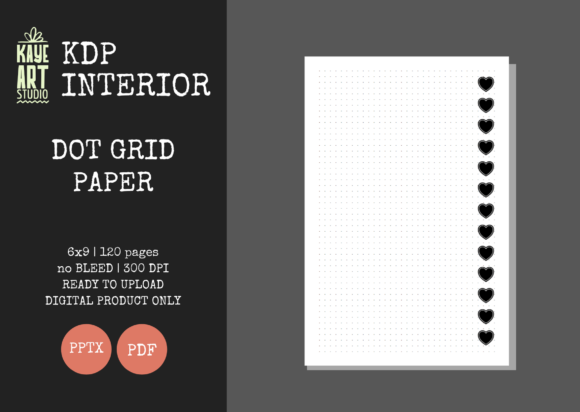
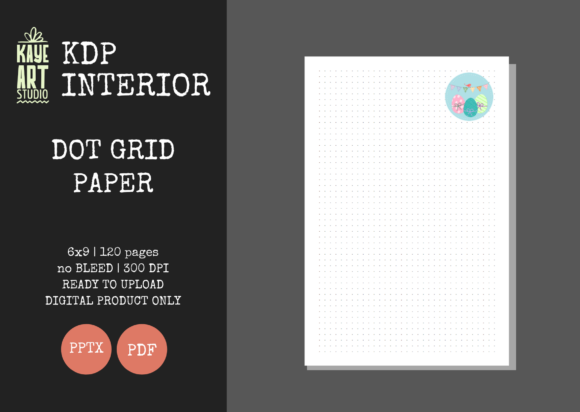
Building a sustainable Amazon KDP business often comes down to balancing quality with efficiency. For publishers focusing on no and low content books, the interior file is the product itself. KDP Dot Grid Paper 95 serves as a foundational asset for creators who need a reliable, professional-grade template without spending hours adjusting margins or recreating grids from scratch. This specific resource provides a 6×9 inch trim size with 120 pages of precision dot grid paper, optimized specifically for the "No Bleed" setting that dominates the functional journal niche.
Unlike lined notebooks which dictate how a user writes, dot grid interiors offer structured freedom. They are currently among the highest-demand formats in the self-publishing space because they bridge the gap between creative expression and organizational utility. Having a pre-formatted, 300 DPI PPTX and PDF file ready for upload removes the technical friction from the publishing process, allowing you to focus entirely on cover design, keyword research, and niche selection.
Real-World Applications Beyond Basic Journaling
While many publishers associate dot grid paper exclusively with bullet journals, the actual market demand extends far beyond daily diary entries. Understanding these varied use cases helps in positioning your book effectively against competitors. The 6×9 format combined with a subtle dot pattern creates a versatile canvas for several distinct audiences.
Technical Sketching and Design Portfolios
Architects, interior designers, and UX/UI professionals frequently prefer dot grids over blank paper because the dots provide scale and alignment guides without the visual clutter of graph lines. A 120-page dot grid notebook in this trim size is ideal for field sketches, wireframing app interfaces, or drafting floor plans. When marketing a book using KDP Dot Grid Paper 95, consider targeting keywords related to "design sketchbooks" or "wireframe notebooks." The no-bleed setting ensures that even if users draw near the edge, the binding remains secure and the layout looks intentional rather than accidental.
STEM Education and Graphing
Students in mathematics, engineering, and science courses often struggle with standard college-ruled paper when plotting functions or drawing molecular structures. Dot grid paper offers the spatial awareness needed for accurate graphing while remaining clean enough for note-taking alongside equations. Because this interior is set at 300 DPI, the dots print crisply, preventing the blurriness that can frustrate students trying to align data points. Publishers can create niche-specific variations by adding a custom title page or subject-specific introduction to the editable PowerPoint file, transforming a generic interior into a specialized academic tool.
Habit Tracking and Wellness Planning
The wellness and productivity community loves dot grids for their flexibility in creating custom trackers. Users build habit grids, mood mandalas, and fitness logs that require both writing space and geometric structure. The 120-page count is particularly strategic here; it represents roughly four months of daily tracking or six months of weekly planning. This duration feels substantial to a buyer looking for value but isn't so thick that it becomes intimidating or expensive to print. The consistent spacing of the dots allows for neat checkboxes and progress bars, which is a major selling point for customers seeking organization.
Leveraging the Editable PPTX File for Differentiation
One of the most significant advantages of this listing is the inclusion of an editable PowerPoint file. In a marketplace saturated with identical PDF interiors, the ability to customize is your competitive edge. You aren't just buying a static document; you are acquiring a flexible framework.
- Add Value Pages: Insert a "This Book Belongs To" page, an index, or numbered pages before the main grid content. These small additions significantly increase perceived value.
- Niche Branding: Create a series of journals for specific professions (e.g., "Nurse’s Shift Log" or "Teacher’s Lesson Planner") by simply updating the first few slides in PowerPoint while keeping the core dot grid intact.
- Instructional Content: For low-content hybrids, add 2-5 pages of prompts, tutorials, or reference material relevant to your target audience before transitioning to the blank dot grid pages.
This customization capability transforms KDP Dot Grid Paper 95 from a commodity into a branded product line. It allows you to test multiple niches rapidly without redesigning the grid geometry each time.
Understanding Technical Specifications and Constraints
Success on KDP requires strict adherence to printing specifications. This interior is designed with specific parameters that influence how you should plan your book project.
The No Bleed Advantage
This file is configured for No Bleed. This means all content, including the dots, sits safely within the printable area with appropriate margins. For new publishers, this is the safest route. It eliminates the risk of content being trimmed off during manufacturing and simplifies the cover creation process since you don’t need to account for bleed overlap. However, it also means the dots will not extend to the very edge of the page. If your brand aesthetic relies on edge-to-edge printing, this specific file would not be suitable. For functional journals where handwriting near the gutter is difficult anyway, no bleed is generally preferred by end-users for readability.
Print Quality and Resolution
The 300 DPI resolution is non-negotiable for professional results. Lower resolution files often result in pixelated or gray dots that look cheap in print. At 300 DPI, the dots appear sharp and dark, providing clear guidance without bleeding through standard 55# or 60# cream or white paper. Always order a physical proof before launching. Seeing the dot density and contrast in person confirms that the file translates correctly from screen to paper, ensuring customer reviews remain positive regarding print quality.
Strategic Considerations Before Publishing
Before uploading files derived from KDP Dot Grid Paper 95, evaluate your market positioning. Since this is an interior-only listing, your cover design carries 90% of the marketing weight. The interior provides the utility that generates repeat customers and good reviews, but the cover generates the click.
Consider the paper color implications. Dot grids typically perform better on white paper for technical and artistic uses due to higher contrast. On cream paper, the dots can sometimes feel softer, which appeals to journalers and writers but might deter engineers. Check current bestsellers in your chosen sub-niche to see which paper color dominates.
Also, be mindful of the 120-page limitation. While perfect for quarterly planners or portable sketchbooks, some users prefer thicker volumes for year-long journaling. Rather than seeing this as a deficit, position it as a feature: "Lightweight," "Travel-Friendly," or "Quarterly Focus." Matching the page count to a specific temporal or functional need makes the book feel purpose-built rather than arbitrary.
Maximizing ROI with Ready-Made Interiors
Time is the most limited resource for independent publishers. Creating a flawless dot grid template involves calculating gutter margins, ensuring dot consistency across 120 pages, and verifying export settings. By utilizing a tested, ready-for-upload solution, you reclaim dozens of hours per title. This time is better spent on market research, advertising optimization, and building a backlist.
The dual file format (PDF and PPTX) offers long-term utility. Keep the master PDF for quick uploads when testing new niches. Use the PPTX when you identify a winning category and want to invest in customization. This hybrid approach allows for both speed and depth in your publishing strategy.
Ultimately, products like KDP Dot Grid Paper 95 are infrastructure. They handle the technical heavy lifting so you can operate as a publisher and marketer. Whether serving students, artists, professionals, or planners, the dot grid remains a timeless format. Success lies not in reinventing the grid, but in applying it thoughtfully to the specific needs of underserved audiences through smart customization and targeted presentation.