Mastering KDP Interiors: A Guide to Dotted Blank Pages with Bleed for Low Content Publishing
The landscape of self-publishing has undergone a dramatic transformation in recent years, shifting from a niche hobby to a legitimate business model accessible to entrepreneurs worldwide. At the heart of this movement is Amazon’s Kindle Direct Publishing (KDP) platform, which allows creators to publish physical books without inventory or upfront printing costs. While high-content books like novels and textbooks dominate traditional publishing, the low-content book market has carved out a significant space for designers and marketers. Among the most versatile and in-demand formats in this category are dotted blank pages with bleed KDP interiors. Understanding the technical specifications, creative applications, and business potential of these 120-page formatted templates is essential for anyone looking to build a sustainable publishing portfolio.
Understanding the Technical Foundation: What Is Bleed?
Before diving into the business strategy, it is crucial to understand the terminology that separates amateur uploads from professional products. In the context of KDP interiors, bleed refers to the printing area that extends beyond the final trim size of the book. When you select "bleed" in your KDP setup, the content on the page must extend 0.125 inches (3.2 mm) past the edge of the paper on the top, bottom, and outside edges.
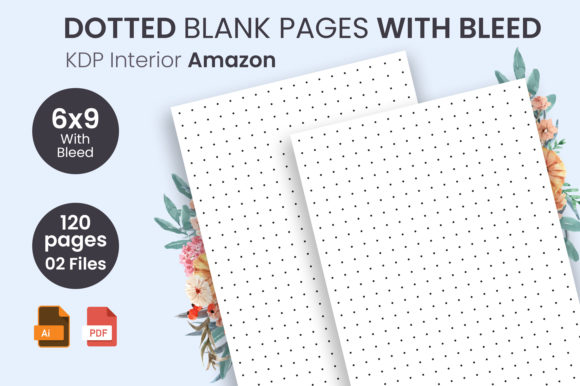
Why does this matter for dotted notebooks? If a dot grid pattern stops abruptly at the margin line, the resulting book will have an uneven white border after trimming due to slight mechanical shifts during the printing process. This creates a visually unprofessional product. A properly formatted dotted blank page with bleed ensures that the grid pattern runs seamlessly to the very edge of the paper, providing a polished, premium feel that customers expect. For a 6" x 9" interior, the actual file size must be 6.125" x 9.25" to accommodate this requirement. Using pre-tested files eliminates the guesswork and prevents common rejection errors related to margin violations.
The Strategic Value of the 6x9 Form Factor
While KDP offers numerous trim sizes, the 6" x 9" dimension remains the gold standard for low-content journals and notebooks. This size strikes a perfect balance between portability and usability. It is compact enough to fit in a purse, backpack, or laptop bag, yet offers sufficient surface area for writing, sketching, and planning. When sourcing or creating interiors, prioritizing this size maximizes your potential audience because it aligns with consumer expectations for standard trade paperbacks and journals.
Furthermore, the 120-page count is strategically significant. It provides enough volume to justify a competitive price point while keeping printing costs low enough to maintain healthy royalty margins. Thinner books can sometimes feel insubstantial to buyers, whereas excessively thick low-content books may deter users who prefer to finish a journal within a specific timeframe. The 120-page sweet spot supports roughly three to four months of daily use, making it ideal for quarterly planning or seasonal tracking.
Versatility of Dotted Grid Interiors
One of the primary advantages of dotted blank pages over lined or plain paper is their inherent versatility. Lined paper dictates a linear structure, and plain paper can feel intimidatingly empty. Dotted grids offer a subtle guide that facilitates both structured writing and freeform creativity. This flexibility allows publishers to target multiple niches with a single interior asset.
- Bullet Journaling: The dot grid is the foundational canvas for the bullet journal method, allowing users to create custom layouts, habit trackers, and calendars without the constraints of pre-printed lines.
- Technical Sketching: Architects, designers, and engineers often prefer dotted grids for drafting diagrams where scale and proportion matter more than handwriting alignment.
- Mind Mapping and Brainstorming: The non-linear nature of dots encourages radial thinking and visual organization, making these interiors perfect for productivity planners.
- Hand Lettering and Calligraphy: Artists use the dots as spacing guides for practicing typography without the visual clutter of heavy graph lines.
By marketing a single "dotted notebook" to such diverse audiences, you significantly increase the discoverability of your book. However, success requires more than just uploading a generic file; it demands thoughtful cover design and keyword research that speaks to these specific use cases.
Leveraging Ready-to-Upload Assets for Efficiency
Time is the most valuable resource for any KDP publisher. Creating a flawless bleed interior from scratch requires graphic design software proficiency and a deep understanding of print specifications. This is where professionally formatted assets become invaluable. Products that include both a ready-to-upload PDF and an editable AI (Adobe Illustrator) file offer a dual advantage.
The PDF file serves as an immediate solution. Having been tested for upload, it guarantees compliance with KDP’s automated review system. This reduces the friction between ideation and publication, allowing you to capitalize on trending keywords quickly. Conversely, the AI file provides long-term value. It allows experienced publishers to customize margins, adjust dot opacity, add branding elements, or modify headers to create unique derivatives. This combination of speed and customizability is what enables scalable business growth rather than one-off uploads.
Building a Sustainable Low Content Business
Succeeding in the KDP low-content space requires shifting your mindset from "uploading files" to "building a brand." The market has matured, and quality now trumps quantity. Using high-quality, bleed-formatted interiors is merely the baseline. To truly stand out, publishers must focus on the user experience and niche specificity.
Consider the concept of niche stacking. Instead of publishing a generic "Dotted Notebook," combine the functional interior with a specific thematic cover and title. A "Gardening Planner with Dotted Notes Section" or a "D&D Campaign Notebook with Dot Grid Maps" targets buyers with higher purchase intent. The interior remains the same versatile 120-page dotted format, but the packaging solves a specific problem for a defined audience. This approach improves conversion rates and reduces competition against the millions of generic notebooks already listed.
Common Misconceptions About Low Content Publishing
New entrants often assume that low content means low effort. This is a dangerous misconception. While the interior creation is streamlined through templates, the business aspects—keyword research, cover design, ad management, and customer analysis—require significant dedication. Another common error is neglecting the importance of file testing. Even if you create your own interiors, always verify them using KDP’s previewer or third-party tools before publishing. Margins that look correct on screen may trigger bleed errors during processing. Utilizing pre-tested assets mitigates this risk entirely.
Additionally, some publishers believe that once a book is live, sales will follow automatically. In reality, KDP is a search engine. Your metadata, including title, subtitle, and backend keywords, must accurately reflect the utility of the dotted interior. Describing the paper weight, the bleed specifications, and the intended uses in your book description helps manage customer expectations and reduces negative reviews related to misunderstandings about the product's physical attributes.
The Role of Continuous Learning and Adaptation
The digital publishing ecosystem is dynamic. Trends shift, algorithms update, and consumer preferences evolve. What sells today may be saturated tomorrow. This makes continuous education and community engagement vital components of long-term success. Following established interior creators and industry experts provides insight into emerging formats, design trends, and platform changes. When providers encourage users to "follow us for latest and high selling KDP interiors," they are offering access to real-time market intelligence that can inform your publishing calendar.
Moreover, analyzing the performance of different interior variations helps refine your strategy. Do your customers prefer lighter gray dots or darker black dots? Do they respond better to minimalist covers or illustrative designs? Treating each book launch as a data point allows you to iterate and improve. The availability of editable source files means you can rapidly adapt to feedback without rebuilding your foundation from zero.
Final Thoughts on Quality and Professionalism
Ultimately, the goal of using professional dotted blank pages with bleed KDP interiors is to deliver a product that rivals traditionally published stationery. Customers do not care whether a book was printed by a major publishing house or an independent creator; they care about usability and aesthetics. By ensuring your interiors are technically sound, correctly sized at 6" x 9", and optimized for the 120-page standard, you establish a reputation for quality. This trust translates into repeat customers, positive reviews, and a resilient publishing business capable of weathering market fluctuations. Whether you are a beginner seeking your first sale or a veteran scaling your catalog, mastering these foundational elements is the key to unlocking the full potential of Amazon KDP.